Custom Gas Assisted Injection Molding Manufacturer in China
Custom gas-assisted molds and molded parts for thick ribs, handles and housings. Control sink, reduce solid mass and validate performance with free DFM and three trial rounds.
- 38% lighter handle; 29% shorter bracket cycle
Separate KTM case results, measured against each part’s baseline; results vary by design and resin.
- Free DFM with a 24-hour first response
DFM and quotation timing follow the drawing review.
- 90–400T in-house; larger presses through partner factories
Tooling, trials and production responsibilities are identified in your quote.
- Three trial rounds and no minimum order quantity
Trial samples are assessed against agreed dimensions, appearance and functional requirements.
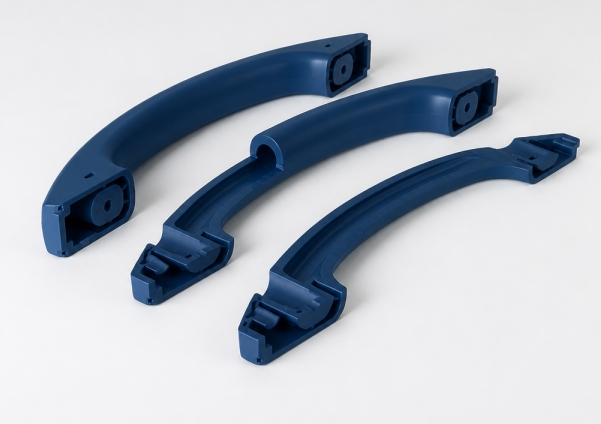
What Is Gas Assisted Injection Molding? Process, Fit, and Risks
How Gas-Assist Molding Works in One Paragraph
Gas assisted injection molding (GAIM) uses pressurized nitrogen to assist resin packing while a plastic part forms. Internal gas assist displaces molten resin within selected thick sections to create hollow channels. External gas assist applies pressure between the part and cavity surface. Both can support packing during cooling; the resin, geometry and chosen process determine the result.

6 Pain Points and Disadvantages to Resolve Before Tooling
-
1
Process-window sensitivity.
Gas timing, shot size, melt temperature, pressure profile, and hold strategy interact. Small changes can alter the skin, fill, or gas path, so the process window must be built from the resin, geometry, and measured shots for consistency.
-
2
Gas blowout and fingering.
If the gas path reaches a weak skin or thin transition, nitrogen can break through and leave a void, finger, or mark. Review residual wall, gate, vents, melt condition, and pressure profile together before accepting a cosmetic zone.
-
3
Trapped gas, burns, and short shots.
Poor venting or an unsuitable transfer condition can trap air, cause burn marks, or leave an incomplete fill. The DFM review maps vents and last-to-fill areas, while T1 inspection checks appearance, fill completion, and the selected process window.
-
4
Uneven gas channels and warpage.
Gas follows the available low-resistance path. Uneven gates, wall sections, or channels can change residual wall and shrinkage, producing distortion. Use flow analysis and sectioned parts to compare the predicted path with the actual drawing and cosmetic limits.
-
5
Multicavity flow imbalance.
In a multicavity tool, differences in flow resistance can change gas penetration from cavity to cavity. Balance the runner and gas route, define cavity-level checks, and choose independent control only when the geometry and validation plan justify it.
-
6
Gas-pin maintenance over long runs.
Gas pins and fittings need a regular maintenance plan because residue or wear can change flow. Define cleaning access, spare parts, checks, and escalation criteria in the tool handover instead of assuming a shot-count threshold fits every mold.
These six failure modes are design and process questions, not problems solved by one pressure setting. A useful DFM review maps gas entry, vents, residual wall, resin window, inspection points, maintenance access, and the evidence required before production.
The next section shows process variants and controls used to select a trial plan.
How Gas Assist Injection Molding Works: 4-Step Process
A gas assisted injection molding process aligns resin flow, gas entry, pressure, cooling, and release. A partial fill may let nitrogen complete and pack the cavity; a full-shot or overflow route may be better for another geometry. The four stages below are a practical process map; exact timing and pressure profile are set from CAE and T1 evidence.
Short Shot or Full Shot
For partial-fill molding, a measured resin shot stops before a full cavity and nitrogen completes selected sections. Full-shot, shrinkage-compensation, and overflow or PEP variants are also available. The choice depends on flow length, thick zones, surface requirements, and whether gas should displace or only pack material.
Nitrogen Gas Injection
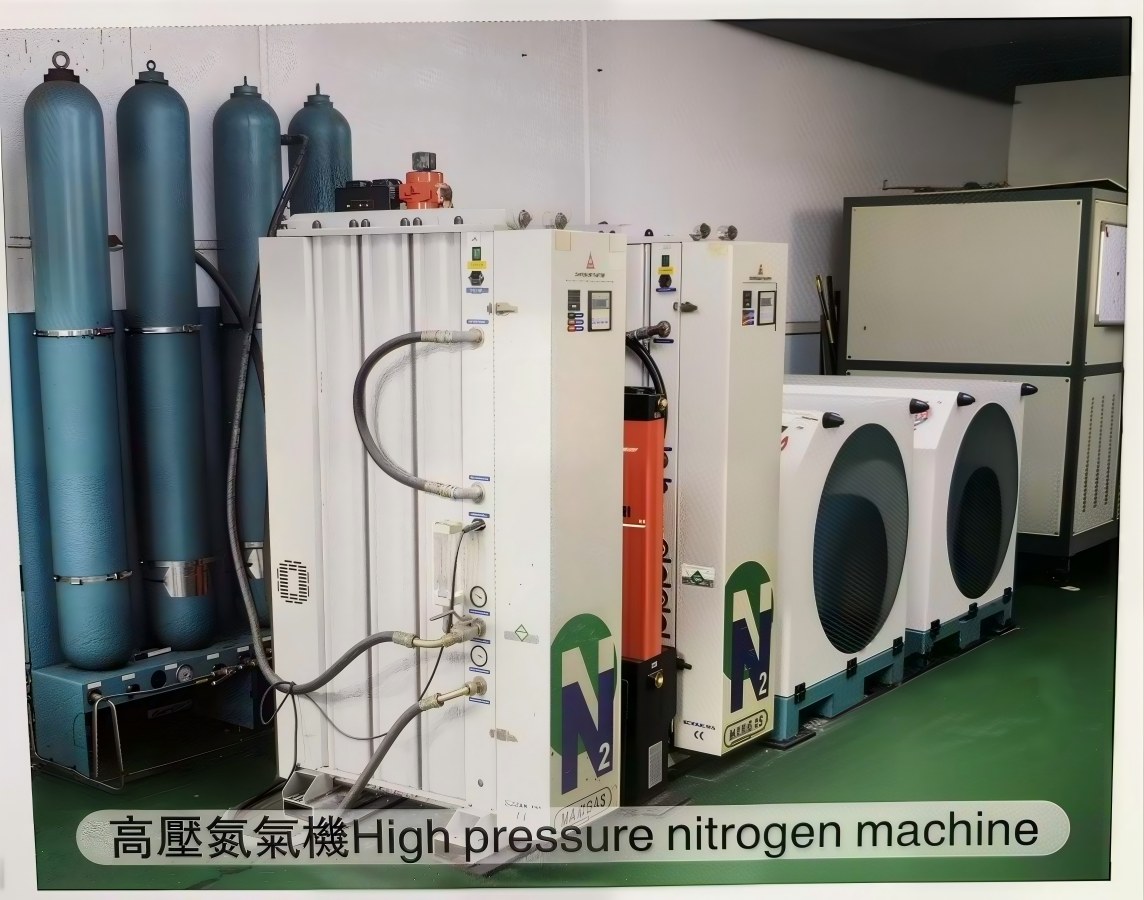
Nitrogen enters through a suitable nozzle or mold gas pin after the resin reaches the planned transfer condition. Pressure and time are selected for the exact resin, wall section, gas-entry method, and tool. Dry-gas specification, safety controls, and measured pressure profile belong in the process plan.
Gas Core Formation
Gas follows the available low-resistance path and displaces or compresses melt in selected thick sections. The tool must guide that path through intended ribs, bosses, or channels. CAE predicts flow; sectioned parts and wall checks confirm residual thickness and channel continuity at specified cut-section inspection locations.
Pack, Cool, Vent & Eject
The tool holds required pressure while the skin and core cool, then releases gas through a controlled route before mold opening. Operators follow the machine and tool work instruction. Ejection and dimensional checks confirm part quality, venting, and safe release; document the sequence before production approval.
The cycle is only one part of the decision. The comparison below covers fit, equipment, runner and gas-entry choices, and the trade-offs against conventional injection.
Gas Assisted Injection Molding vs Conventional: 8-Point Comparison
Gas assist can solve selected thick sections; custom injection molding without gas assist may suit uniform walls and optical work. Compare geometry, material, equipment, validation, and cost against your actual baseline before choosing a route.
| Item | Gas Assisted Injection | Conventional Injection |
|---|---|---|
| Wall thickness range | Geometry- and resin-specific; review thick sections and residual wall in CAE and trials | Often preferred for uniform thin walls; design remains resin- and tool-specific |
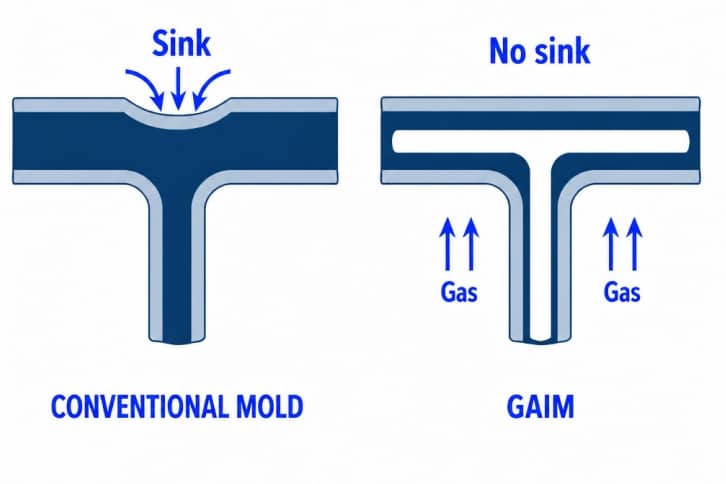
| Sink marks on thick areas | Can reduce sink in suitable thick zones; confirm appearance in trials | May show sink where thick sections cannot pack effectively; tune geometry and cooling |
| Cycle time on thick parts | May be shorter in selected thick sections; measure against the approved baseline | Cooling remains governed by solid sections, geometry, resin, and tool design |
| Required clamp force | May reduce packing or clamp demand; confirm machine load from analysis and tryout | Size the press from projected area, pressure, mold, and validated process conditions |
| Material cost | Potential resin reduction; calculate from the solid baseline, price, scrap, and annual volume | Uses the designed solid volume; compare weight, cycle, scrap, and part performance |
| Class A surface on thick zones | Surface result depends on gas path, skin, vents, material, and the agreed cosmetic trial | May need geometry, packing, cooling, or secondary-finish changes for thick zones |
| Equipment | Compatible press + nitrogen control + nozzle or gas pins + gas-designed mold and safety controls | Compatible press and conventional mold, subject to the resin and geometry |
| Best-fit geometries | Handles, thick ribs, tubes, and selected panels after route and cosmetic review | Uniform thin walls, small parts, and some optical work after its own validation |
Do You Need a Special Injection Machine? Check the Press and Tool
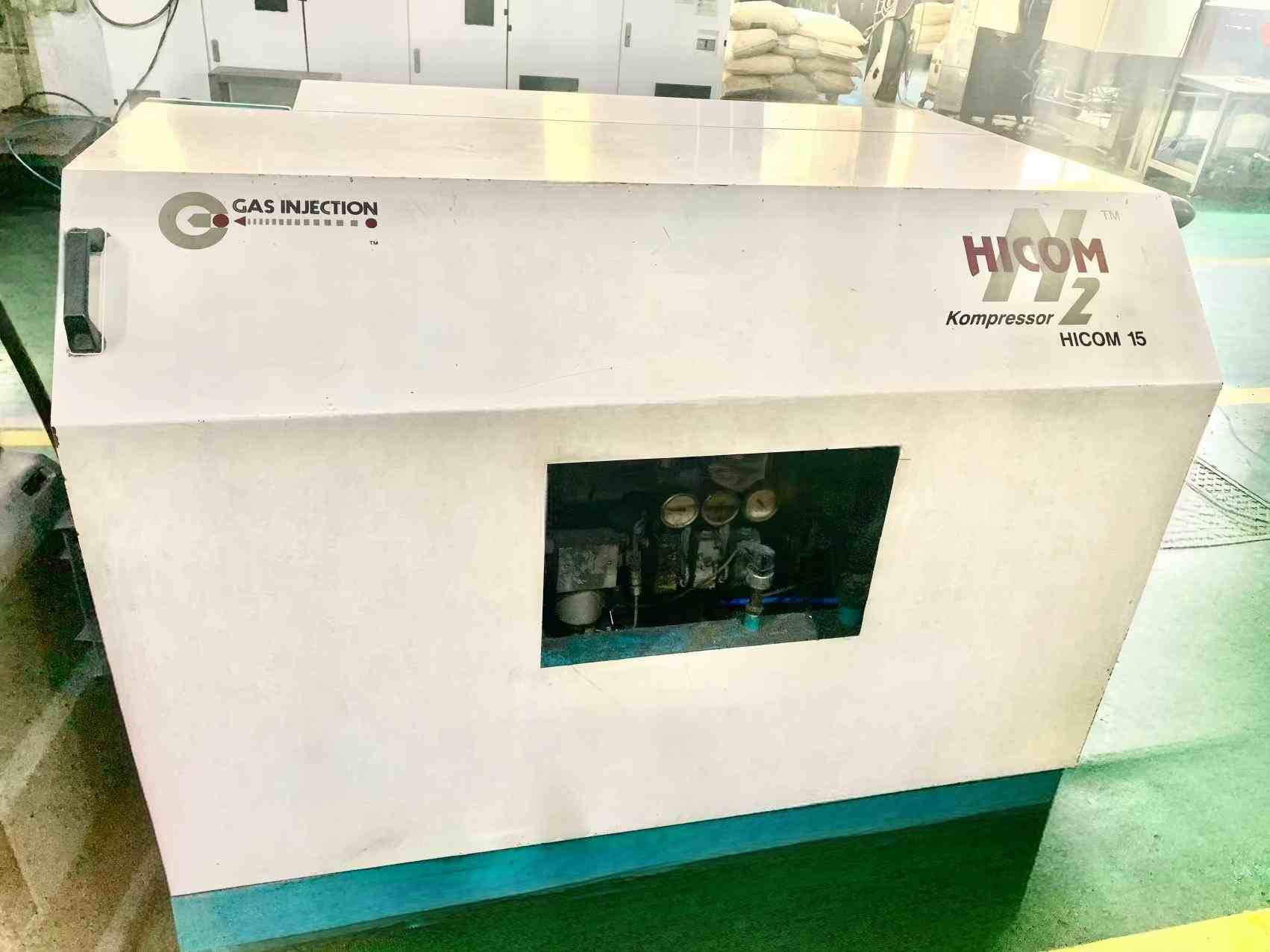
Many standard injection presses can run gas assisted injection molding when the press interface, nitrogen supply and control, gas-entry hardware, safety controls, and mold are compatible. The equipment package should be selected with the process route, not assumed from the press label.
• A dry nitrogen supply and control system matched to the selected resin and equipment• A compatible nozzle or in-mold gas pins, depending on the gas-entry method• A mold designed or adapted for the intended gas path, vents, and controlled release For nozzle gas injection, use a compatible cold-runner route. Direct gas pins in the mold or runner can support hot-runner systems. Existing molds need a review of gates, wall sections, ejectors, vents and gas release before conversion; identify the hardware changes and trial plan in the quotation.
Internal vs External Gas Assist
Two approaches solve different problems:
Internal gas assist introduces nitrogen into the melt through a nozzle or gas pin so it can core selected thick sections such as handles, ribs, tubes, or brackets. Gas-channel size and residual wall are geometry-specific; CAE and sectioned trials confirm the intended path.
External gas assist places gas between the part surface and cavity wall to press resin against the tool. It can suit selected large panels or cosmetic zones, but surface, venting, sealing, and process controls need review. Compare it with internal gas, conventional packing, and other routes from the drawing.
Not sure which fits your part? Request a route review with your CAD package and annual volumeThe next module connects the engineering trade-offs to tooling, resin, press hours, validation, and machine cost.
4 Key Benefits of Gas Assisted Injection Molding
Four outcomes commonly drive the business case for gas assist: resin use, surface quality, cooling demand, and clamp or press demand. The result is project-specific, so the comparison should use your solid baseline, resin, tool, cycle definition, and acceptance criteria.
Material Cost Reduction from a Measured Baseline
A gas core can replace resin in selected thick sections, but savings depend on the solid baseline, resin price, wall design, cavitation, cycle, and scrap rate. We compare part weight and resin demand from CAD, then confirm changes with measured shots and agreed functional tests before building the business case.
Sink Marks Reduced on Suitable Thick Sections
Internal or external gas pressure can reduce sink and molded-in stress in suitable thick sections by supporting the skin during cooling. Results depend on gate, gas path, vents, material, texture, and process window. Define cosmetic acceptance on the drawing, then check T1 and repeat parts before approving the final surface.
Cycle Time May Fall in Selected Thick Sections
Hollowing thick sections reduces the resin mass that must cool before ejection. Compare conventional and gas-assisted cycles using the same start and finish events, resin, cavity count and acceptance standard. Record stable production cycles, including filling, packing, cooling, mold movement and ejection; account for maintenance downtime separately when estimating capacity.
Clamp Demand May Be Lower
Gas pressure can reduce packing demand in selected geometries, which may affect press selection. Confirm projected area, resin pressure, mold condition, gas profile, and safety margin with analysis and tryout. A smaller press is possible, not a general rule; state machine ownership and partner scope in the quote and handover.
Which outcome matters most depends on geometry, resin, annual volume, baseline cycle, and acceptance tests. The industry breakdown below shows where buyers commonly evaluate gas assisted injection molding.
Industries We Serve with Gas Assisted Injection Molding
These four application groups commonly evaluate gas assisted injection molding. Fit still depends on the part’s geometry, resin, cosmetic zones, annual volume, and validation plan; confirm the exact production and equipment scope for your program.
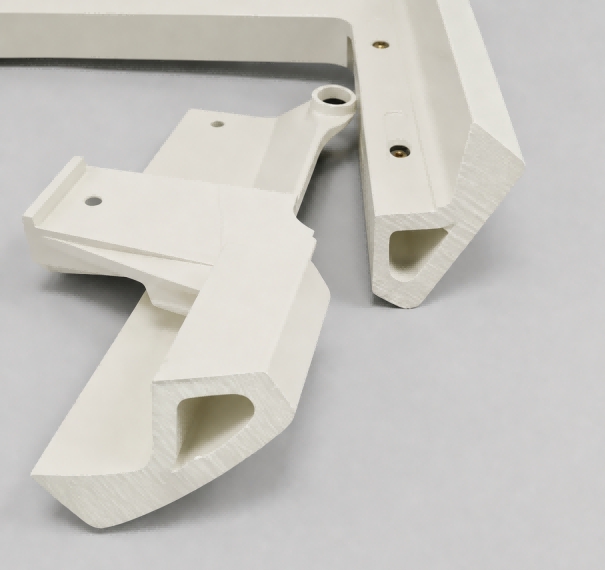
Automotive Gas Assist Injection Molding
Automotive interiors use GAIM for grab handles, trim supports, seat structures, and housings where thick sections drive sink or weight. Review resin grade, fiber orientation, Class A zones, load cases, and gas route before confirming tooling or scope.
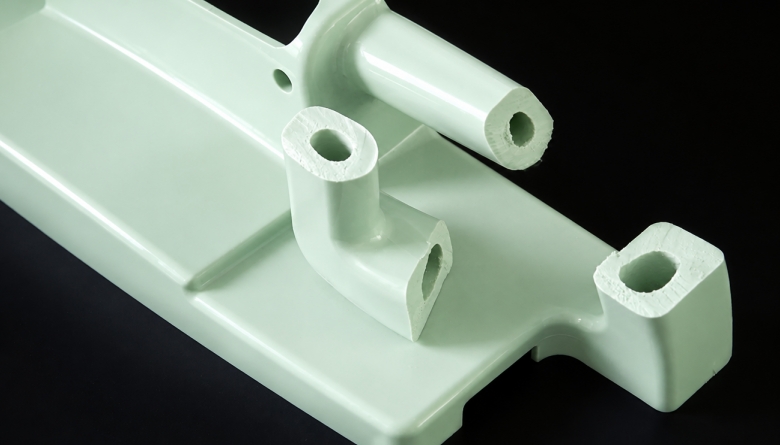
Home Appliance Gas Assist Molding (Handles & Housings)
Appliance handles, housings, and panels can benefit when thick transitions create sink, weight, or cooling concerns. Compare internal and external gas routes, surface texture, resin grade, pull or impact loads, and assembly requirements before selecting the tool concept.
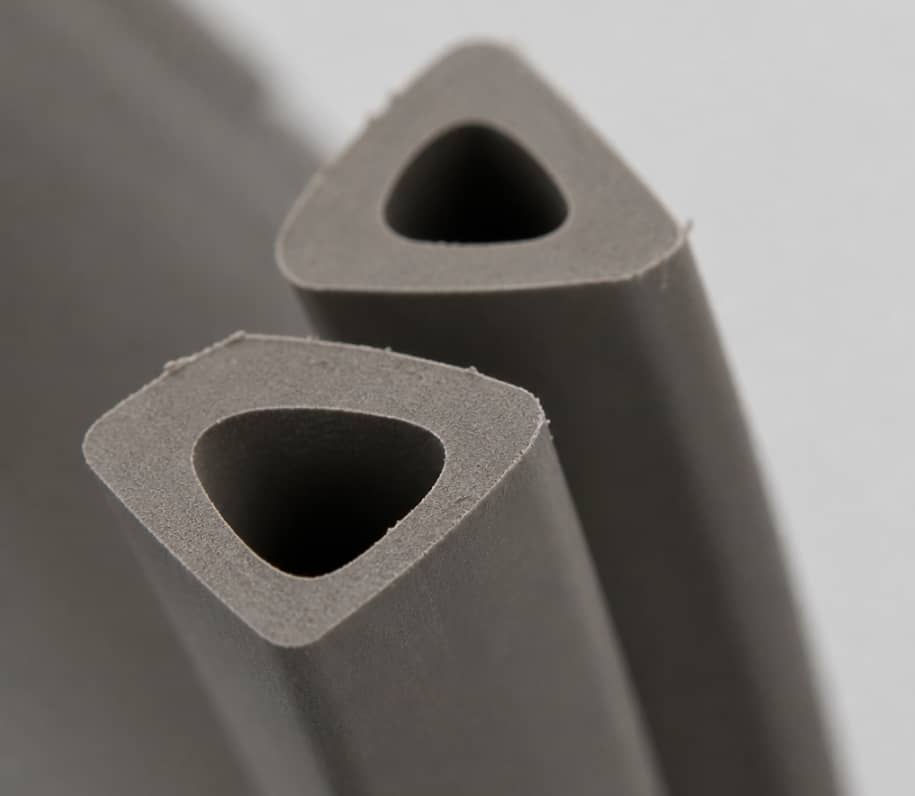
Electronics Gas Assist Molding
Electronics enclosures and control-panel frames may use gas channels beneath ribs to protect the visible face while controlling weight. Define zones, texture, flatness, bosses, shielding or assembly needs, resin grade, and inspection method before approving the final surface.
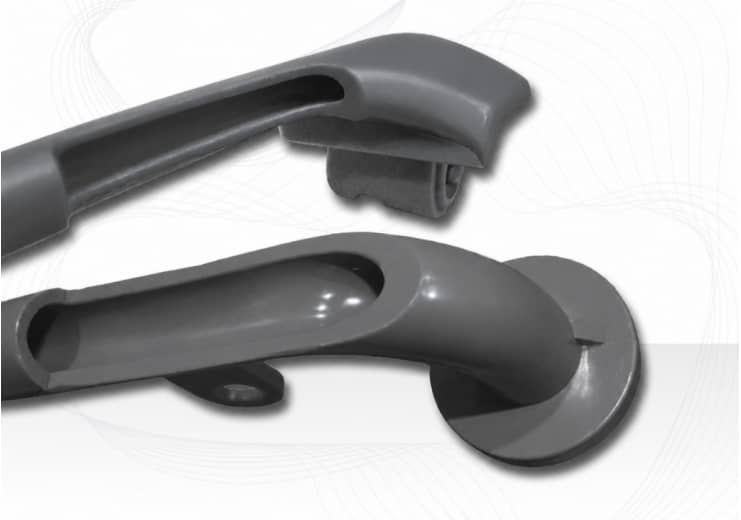
Industrial Gas Assist Components
Industrial brackets, manifolds, fittings, and frames can be candidates when stiffness and weight compete with thick-section cooling. Review pressure loads, sealing surfaces, internal passages, fiber orientation, environmental exposure, resin shrinkage, and the specific inspection plan before choosing GAIM.
The design guide below explains which wall sections, resin properties and gas paths need review before tooling. Later case studies show how those decisions addressed specific cosmetic, weight and cycle-time problems in KTM projects.
Gas Assist Injection Molding Design Guide & DFM Best Practices
Many gas-assist defects begin with geometry decisions made before steel is cut. The checks below are DFM topics rather than universal limits; the named resin, gas-entry method, cosmetic zones, loads, and acceptance tests set the engineering envelope for each part.
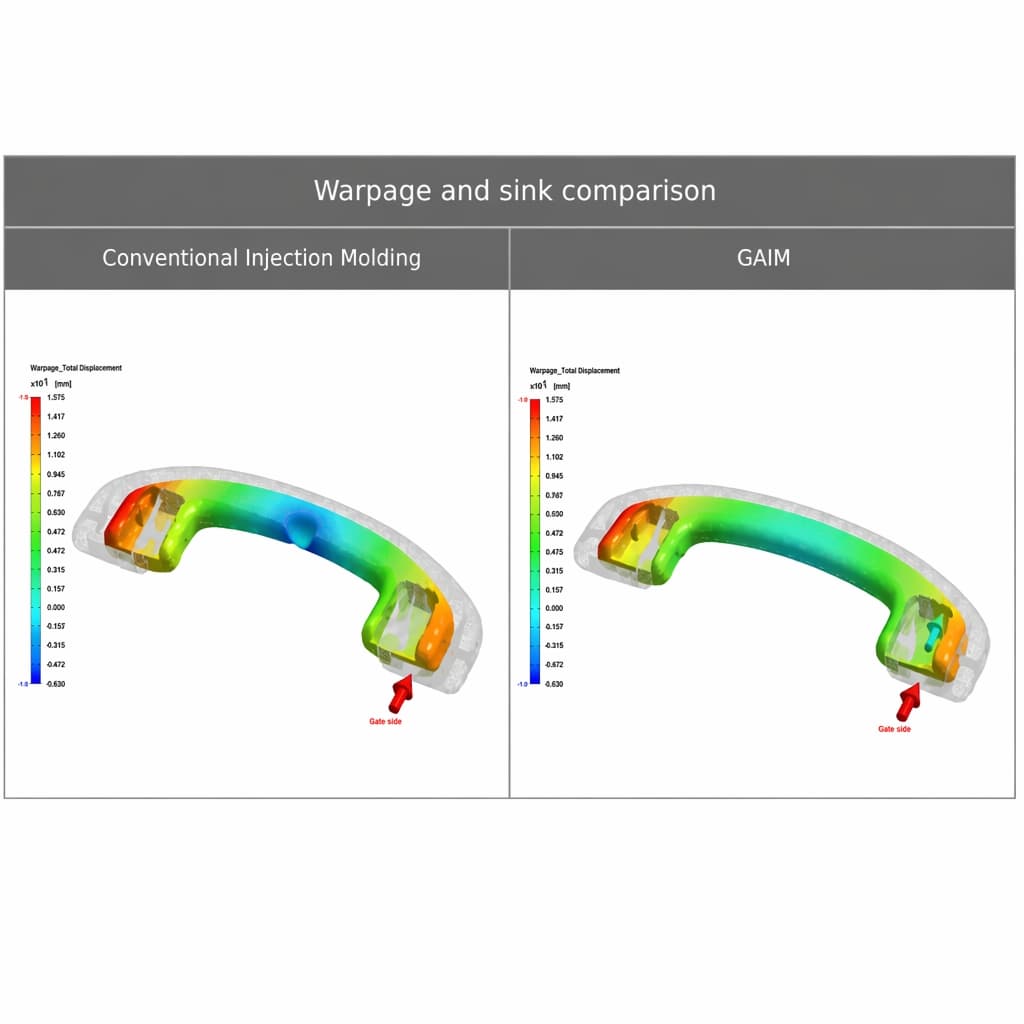
Wall Thickness Guidelines
Start with a nominal wall that the selected resin and finish can fill consistently. Treat thickness, transitions, and residual-wall figures as design variables; use flow analysis before tooling, then section trial parts to check skin support, cooling, sink risk, and dimensional stability directly against the drawing.
Rib & Boss Geometry
Size ribs and bosses from load, draft, sink risk, and intended gas path. Keep transitions smooth, provide radii, and review ejection access. A gas core may support a thicker feature; use CAE and sectioned samples to check residual wall and fiber orientation for the named resin.
Gas Channel Layout & Gating Strategy
Route gas from the gate, flow front, thick section, and last-to-fill area; symmetry is a design goal rather than a fixed ratio. Choose nozzle or direct-pin entry, runner type, vents, and inspection sections together, then compare the predicted path with sectioned T1 parts for release review.
Pressure & Injection Timing
Set gas pressure, delay, hold, and resin conditions from the material grade, wall section, gas-entry method, and trial response. For PA or filled grades, follow the supplier drying and processing window; record shot size, pressure trace, temperatures, and acceptance results instead of copying a universal recipe.
Material Selection Matrix
These examples are a screening matrix, not fixed pressure specifications. The exact grade, additives, moisture condition, cosmetic target, and acceptance tests determine the process window; confirm it with CAE and measured shots:| Resin | Use Case | DFM Focus | Notes |
|---|---|---|---|
| ABS / PC-ABS | Trim, housings | Surface, flow, and sink acceptance | Review surface and cosmetic zones |
| PP / HDPE | Industrial brackets | Shrinkage, flow balance, and wall support | Review melt strength and shrinkage |
| PA6 / PA66 | Structural handles | Drying, moisture, flow, and residual wall | Dry and process to supplier grade limits |
| PA66+30% GF | Load-bearing parts | Fiber orientation, load, wear, and surface | Review fiber orientation, wear, and surface |
| PC | Electronics enclosures | Optical zone, stress, and appearance | Clear and optical zones need dedicated validation |
| PBT | Connectors, structural | Drying, crystallization, and dimensions | Review shrinkage and dimensional targets |
Share the CAD formats available, preferably a ZIP package with STEP, STP, or IGES plus a 2D PDF drawing, target resin, annual volume, cycle baseline, and expected review output. Tell us if an NDA is required; we will confirm the transfer route and reply within 24 hours with the next DFM inputs.
Request a preliminary DFM reviewThe case studies below illustrate these design decisions. Each new part still needs its own gas-path review and trial acceptance plan. By the KTM Mold team. Process references: British Plastics Federation; Autodesk Moldflow. These references explain process principles; KTM project settings are validated in tool trials.

Free DFM review · Itemized quote · First response within 24 hours
Send the CAD formats available, a 2D PDF drawing if available, resin, annual volume, and expected review output. We will confirm the transfer route and the agreed review schedule.
KTM Gas Assist Capabilities & Why Source from China
Gas-assist tooling and production are coordinated under one project team in Dongguan, China. KTM’s in-house molding range is 90–400T; larger parts are produced with partner factories. The team handles DFM, Mold Flow review, tooling, trials, inspection, and export documentation within the agreed project scope.
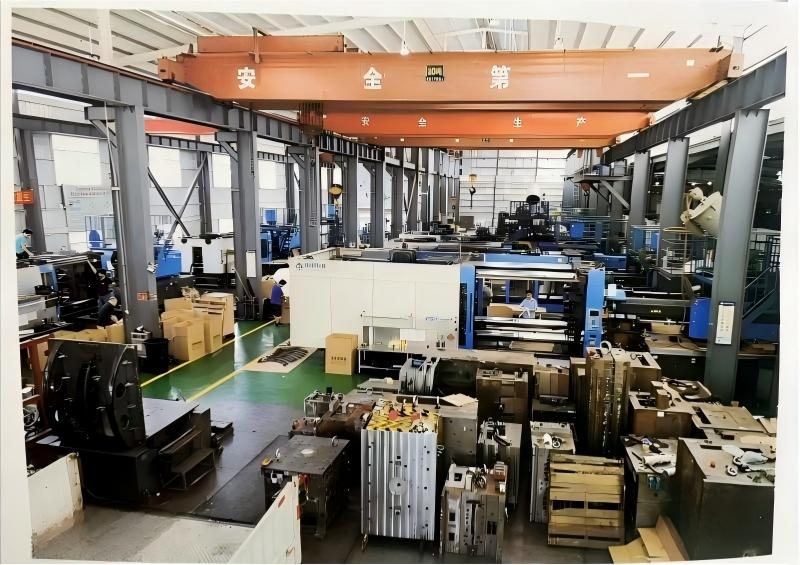
Injection Machines & Tonnage (90–400T In-House)
Our in-house presses cover 90–400T. Larger parts are produced through partner factories with the required press and gas-assist equipment. We identify the production location and trial responsibility in your quotation. Press selection considers projected area, injection capacity, mold dimensions and clamp demand, alongside the nitrogen controller and gas-entry interface requirements.
Tool Steel & Service Life
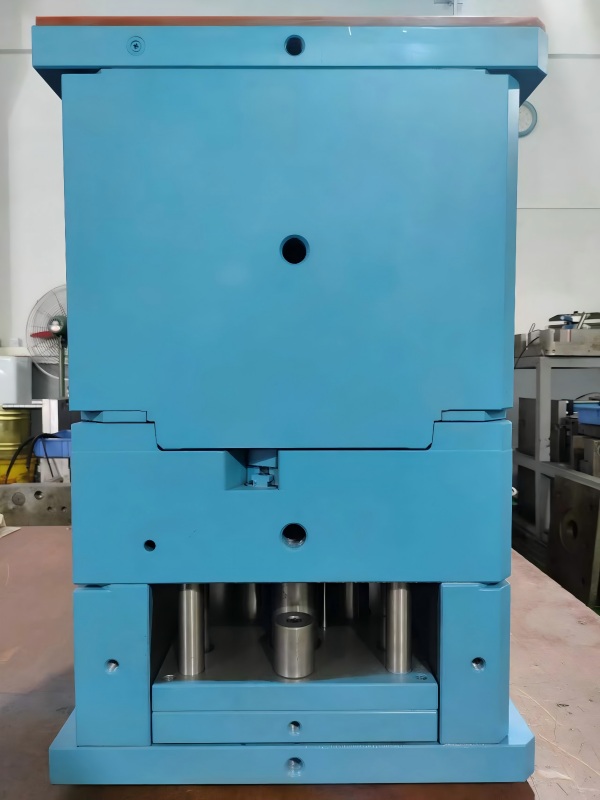
Steel selection follows your resin, planned volume, surface finish and maintenance conditions. Options include P20, 718H, NAK80, H13, S136 and 2738. The quotation specifies the selected grade and treatment, with certificates and inspection requirements defined for the project. Expected tool life depends on operating conditions, wear and the maintenance plan.
HASCO & DME Mold Standards
HASCO or DME components can be specified for export molds. We match the build requirements to your receiving press, locating features, connections and maintenance stock. The handover scope identifies the component BOM, spare parts and drawing package, including any adaptors needed for the gas-entry system and local installation at destination.
English Project Engineering & Technical Review
Your inquiry receives an initial response within 24 hours. English project communication connects DFM comments, gas-channel decisions, toolmaking progress and trial feedback. We establish the review schedule after receiving your drawing and resin information, with responsibilities identified for each approval stage and for partner production when larger presses are required.
Inspection & Quality Reports
A gas-assist part needs evidence beyond its outside dimensions. The inspection plan links drawing datums and cosmetic zones to residual-wall sections, channel continuity, weight and functional tests. Dimensional reports, material records, FAI or PPAP requirements are scoped before production, so sample quantities, measurement methods and acceptance criteria support your application.
Why Source from Dongguan, China
Source gas-assist tooling and molded parts through KTM’s Dongguan project team. Compare quotations using the same steel, cavity count, gas equipment, trial scope and acceptance requirements. We distinguish in-house production from partner work and identify export handover needs, helping you assess tooling cost together with freight, duties and installation requirements.
The following KTM projects connect gas-channel decisions to measured part outcomes. Their materials, cavity counts and cycle times show how different applications require different tooling and process choices.
Gas Assisted Injection Molding Case Studies
These four KTM projects started with a specific defect or production constraint. Materials, fill percentages and gas pressures are project settings, not general recipes. Reported savings apply to the stated part and baseline; new designs require their own trials.
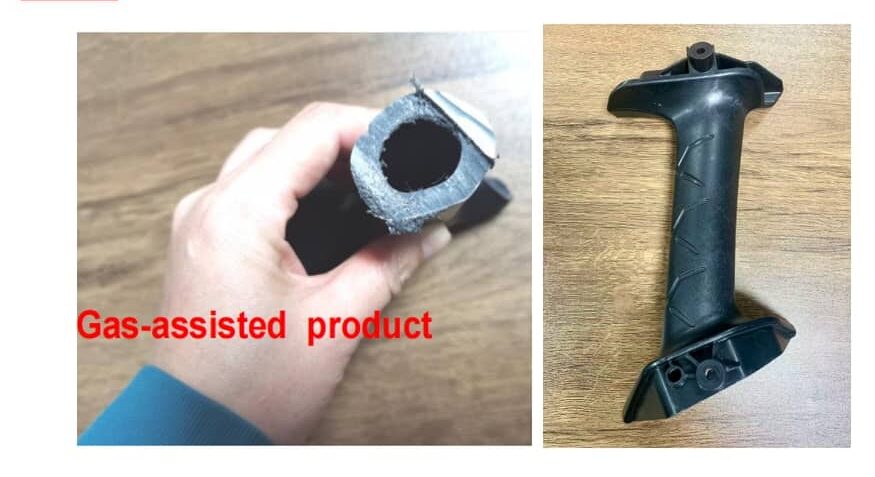
Case 1 — Automotive ABS Housing | Sink Mark Elimination | USA
- Problem:
- 6 mm reinforcement boss produced visible sink on a Class A show face; conventional packing could not close it.
- Solution:
- Gas channel routed through boss center; gate relocated to move witness line off show face.
- Process:
- Nitrogen at 2,800 psi, triggered at 82% mold fill.
- Build:
- Cycle 50s · Tooling 1×1 · Material ABS · Steel 718H
- Result:
- Sink eliminated at T1, verified across a 1000-shot capability run.

Case 2 — Electronics PA6 Cover | Hidden Gas Channels | Europe
- Problem:
- Printer enclosure required a flat Class A face with internal stiffening ribs that sank under conventional packing.
- Solution:
- Gas channels routed beneath the rib network — cosmetic surface remained untouched.
- Process:
- Nitrogen at 3,200 psi, triggered at 85% mold fill.
- Build:
- Cycle 60s · Tooling 1×2 · Material PA6 · Steel H13
- Result:
- Class A surface preserved, ribs hollowed, part weight down 12%.
Case 3 — Home Appliance Handle | 38% Weight Reduction | Mexico
- Problem:
- Washing machine grab handle in PA66+30% GF carried a 12 mm solid core, over-consuming a premium resin.
- Solution:
- Gas-assist hollowed the core to a uniform 4 mm wall.
- Process:
- Nitrogen at 4,500 psi, triggered at 78% mold fill.
- Build:
- Cycle 45s · Tooling 1×2 · Material PA66+30% GF · Steel S136
- Result:
- Part weight down 38%, pull-test load unchanged per customer spec.
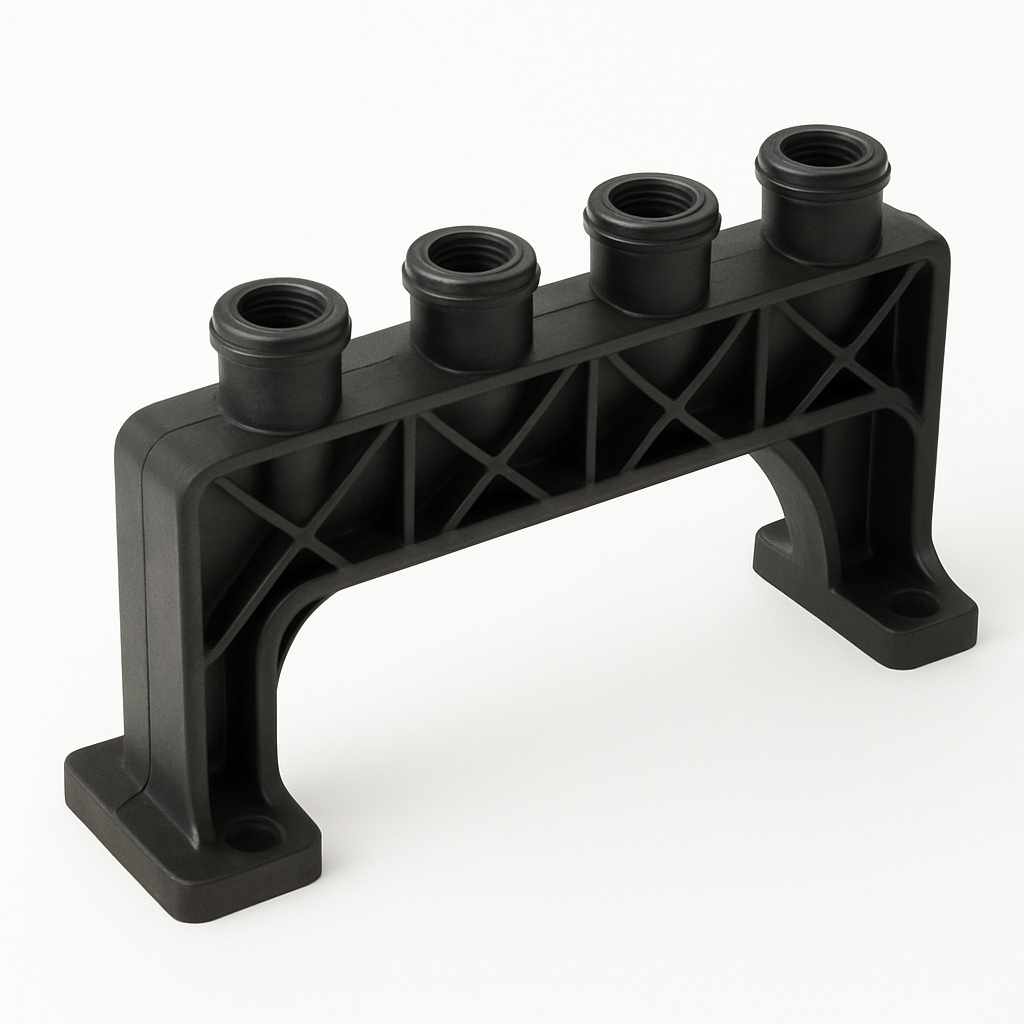
Case 4 — Industrial PP Bracket | 29% Cycle Reduction | Europe
- Problem:
- Irrigation manifold bracket ran 92s per cycle in conventional injection, capping annual output.
- Solution:
- Gas-assist hollowed the structural ribs; cooling channels redesigned around gas paths.
- Process:
- Nitrogen at 2,500 psi, triggered at 88% mold fill.
- Build:
- Cycle 65s · Tooling 1×4 · Material PP
- Result:
- 29% faster cycle at the same press tonnage, freeing capacity for a second family tool.
For your part, share the current weight, cycle time or cosmetic defect alongside the drawing. These inputs let us compare a gas-assist route with your existing process and explain the tooling costs below.
Gas Assist Injection Molding Cost & Pricing Transparency
A gas assisted injection molding quote should separate tooling, gas equipment, trials and recurring part cost. Compare both processes using the same resin, annual demand, acceptance criteria and delivery scope. Break-even quantity equals additional upfront investment divided by net saving per acceptable part. If that saving is zero or negative, gas assist has no volume-driven cost payback; quality or design benefits must justify it.

What Drives Your Gas Assist Tooling Cost
The six line items below are quote drivers; request an itemized amount for each rather than relying on a generic mold price.
Undercuts, slides, lifters, deep ribs, draft limits, and inspection access add machining or EDM work. Gas channels, vents, and service features change the estimate. We price these items from CAD and state all design assumptions clearly before steel is ordered.
Part geometry complexity
More cavities increase tooling size, gas-pin hardware and balancing work. Select cavitation from annual demand, achievable cycle time, press capacity and cavity-level quality checks. A larger tool only improves economics when stable output offsets its additional investment and maintenance requirements.
Cavity count
Compare steel grades against abrasive fillers, production volume, corrosion exposure and surface finish. Specify the selected grade, heat treatment, target hardness and certification requirements. Tool life also depends on maintenance and operating conditions; a steel name alone cannot guarantee it.
Mold steel grade
Nozzle gas injection requires a compatible cold-runner route; direct gas pins can pair gas assist with a hot runner mold. Include gas-pin positions, valve sequencing, cavity control and maintenance access in the estimate. Weigh manifold cost against runner scrap, production volume, process stability and servicing.
Gas channel & runner
Polish, texture, grain, and cosmetic-zone requirements change machining, handwork, inspection, and approval time. Name the SPI or texture reference and identify surfaces that are functional, visible, or subject to an approved sample before final mold quoting to avoid texture rework.
Surface finish
GAIM trials may need a nitrogen unit, gas-entry setup, process engineer, sectioned samples, and repeat runs. Quote the scope, sample count, measurement method, rework responsibility, and validation timing separately so the cost and schedule are fully visible before ordering steel.
Trial cost
Prototype vs Production Tooling
Prototype and production steel should be selected from design maturity, annual volume, wear, surface, and acceptance needs. A simpler tool can validate flow before hardened steel, but lower upfront cost may change life and finish. Put tool life, change limits, and upgrade path clearly in the final quote.
Trial Shot Policy (No Hidden Fees)
Three trial rounds are included when the drawing, resin, wall thickness, and cavity plan stay within the agreed DFM scope. If a process defect requires rework, record responsibility and response timing; design or material changes after steel is cut are quoted separately and approved before any work starts.
Export Tool vs In-House Production
Export the tool to a compatible nitrogen-equipped press or keep production with KTM’s project team; No MOQ is available for the confirmed service scope. Agree HASCO or DME requirements, machine interface, inspection records, production ownership, batch reports, freight, and partner-factory work in writing for the receiving production plant.
Before committing to a quote, the next section identifies fit conditions where conventional injection, overmolding, two-shot, a mechanical core, or another assisted process may be a better route.
When NOT to Use Gas Assisted Injection Molding
Gas assist is a design choice, not a default. A DFM review should compare geometry, resin, appearance, tolerance, validation burden, and annual volume before tooling. The four screens below flag projects that need another route or a more detailed process study.
Use these screens before requesting a quote:
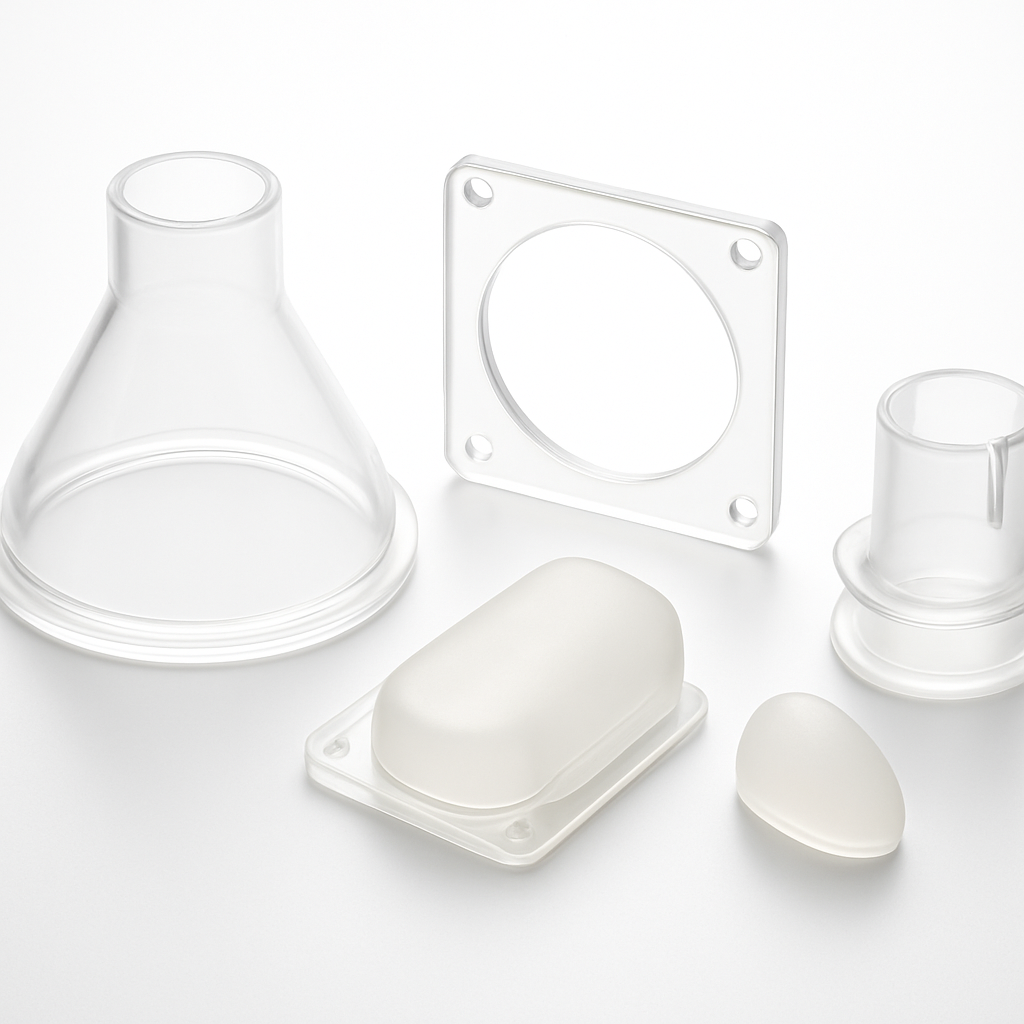
Transparent or optically clear resins.
Treat clear and optical grades as a special review, not an automatic exclusion. Gas paths, residual stress, wall variation, and birefringence can affect appearance or function. Name the grade, optical zone, haze or transmission target, and cross-section method before choosing GAIM or conventional molding with representative molded samples.
Uniform thin-wall parts with no suitable thick section.
If the part has no thick section for gas to displace, a gas process may add controls without clear material or cooling benefit. Compare balanced conventional injection, gating, and cooling against the actual wall range and cosmetic limits; do not use 1.5 mm as a universal pass-or-fail rule.
Multi-cavity tools with mismatched cavity volumes.
Gas follows the path of least resistance. When cavities differ in volume, wall thickness, or flow resistance, one may fill or core differently from another. Balance the tool, consider independent control, and define final cavity-level checks before deciding whether a family mold or separate tools carry less risk.
Hollow channels needing tight internal ID tolerance.
Gas-formed cores are not substitutes for precision mechanical cores. Functional IDs need a dedicated review of size, straightness, surface, pressure or flow duty, and inspection method; a projectile, mechanical core, or another molding route may be more appropriate when bore dimensions control sealing, fluid flow or assembly fit.
If a screen applies, we can compare conventional injection, overmolding, two-shot, mechanical-core, projectile, or other documented routes against your drawing and acceptance criteria. Choosing the process before cutting steel protects the tooling budget.
Still weighing whether gas assist fits your part? The questions below cover the decisions buyers make before sending CAD, resin, and volume data.
Gas Assisted Injection Molding FAQ

These ten questions cover the decisions buyers should make before sending CAD. If your project has a different constraint, describe the part, resin, volume, and acceptance target so the review can focus on fit, risk, and next steps.
Q1: How do I know whether gas assisted injection molding fits my part?
GAIM is most promising when thick ribs, handles or bosses cause sink, excess weight or long cooling. A viable design needs a controllable gas path and acceptable residual walls. Send the drawing and current defect or cycle baseline for a fit review.
Q2: Can an existing conventional mold be converted to gas assist?
Sometimes. Retrofit feasibility depends on the existing gate, wall section, parting line, ejectors, vents, gas-entry route, tool steel, and press interface. We review the tool drawing and CAD, then identify reusable inserts, required hardware, and a validation plan. A new gas-designed tool may be lower risk.
Q3: Do I need a special injection machine or gas-assist equipment?
Many standard injection presses can run GAIM when the press interface, nitrogen source and control system, nozzle or gas pins, safety controls, and mold hardware are compatible. Confirm clamp demand, injection capacity, controller signals, and installation ownership before quoting; press tonnage and equipment scope remain project-specific.
Q4: What is the difference between internal and external gas assist?
Internal gas assist introduces nitrogen into the melt to core selected thick sections such as handles, ribs, or tubes. External gas assist places gas between the part surface and cavity wall to press resin against the tool. Gate, geometry, cosmetic requirements, residual wall, and controls determine the appropriate route.
Q5: Which resins work with gas assisted injection molding?
ABS, PC/ABS, PC, PP, HDPE, PA and PBT can be candidates. The specific supplier grade determines drying and processing conditions. Filled grades need particular attention to fiber orientation, surface finish and strength in the remaining wall; suitability is confirmed in trials.
Q6: Can clear PMMA or optical PC use gas assist?
Sometimes. The deciding issue is whether the gas path or residual stress affects an optical zone. Supply the exact grade and haze, transmission or appearance limits; trials must demonstrate these are met. Conventional molding may be preferable when optical requirements dominate.
Q7: How much does gas assisted injection molding cost?
Tooling cost depends on geometry, cavity count, steel, runner and gas-entry method, finish, trial scope, and production ownership. Per-part economics also depend on resin, cycle baseline, scrap, and annual volume. Ask for an itemized quote that states assumptions, included trials, rework terms, freight, and equipment scope.
Q8: How are gas channels, residual walls, and internal IDs validated?
Validation links the drawing to the gas path and acceptance plan. Define section locations, residual-wall checks, dimensions, appearance, weight, cycle definition, and functional loads; record material and process data during T1 and repeat shots. CMM, gauges, sectioned parts, or other methods are selected for the feature.
Q9: What should an export tool handover include?
Agree the mold standard, component BOM, steel and heat-treatment records, spare parts, drawing package, maintenance instructions, and acceptance reports. HASCO or DME may be specified when compatible with the receiving plant; confirm actual interchangeability, adaptor or local-service needs, and production ownership before handover.
Q10: What should I send for a gas assisted injection molding DFM review?
Send CAD in a ZIP, a 2D PDF drawing, resin grade, expected volume and the problem you need to solve. Flag critical dimensions or functional loads. Mention any NDA requirement before sharing files. We provide an initial response within 24 hours and establish the DFM schedule after review.
Get a Free Gas Assisted Injection Molding DFM Review
Send your CAD in a ZIP with a 2D PDF drawing, resin grade and expected order volume. Highlight the sink mark, weight, cycle time or hollow-section requirement you need to solve. We will respond within 24 hours to establish the free DFM and quotation schedule. If an NDA is required, mention it before sharing confidential files.
Prefer to discuss the project first?